What if the right EV charger wiring for your neighbour’s home isn’t right for yours? EV charger electrical wiring requirements depend on the charger, the property’s electrical supply and the route from the switchboard to the parking space. There’s no single cable size or circuit specification that suits every installation.
In Sydney, an electrician needs to assess the existing switchboard and supply before recommending an installation. A dedicated circuit, suitable protective devices and enough capacity for the charger all matter. If the switchboard needs an upgrade, identifying that before work begins helps plan the installation properly. Fixed electrical work must be carried out by a licensed electrician.
This guide explains what affects wiring, how charger power influences circuit requirements and when a property may need electrical upgrades. You’ll also learn what a professional assessment covers and why safe installation is planned around your home or business, not just the charger. Brighter Sparks Electrical Pty Ltd installs EV chargers and related electrical upgrades across Sydney, helping property owners plan a practical next step.
Key Takeaways
- EV charger electrical wiring requirements vary by charger and property, so one cable or circuit specification won’t suit every installation.
- Your vehicle’s AC charging capability affects how useful a charger’s power rating may be.
- An existing switchboard doesn’t automatically rule out a charger. Its capacity and condition help determine the installation approach.
- Have your vehicle details, parking position and preferred charger location ready to make installation planning more straightforward.
- Note major household loads and any planned solar or battery installation, as these can inform the property assessment.
What do EV charger electrical wiring requirements actually cover?
EV charger wiring needs a site-specific assessment because a safe installation depends on the charger, its location and the electrical infrastructure already in place. EV supply equipment (EVSE) refers to the charging equipment and electrical connection that delivers power from a property to a vehicle. Planning involves more than choosing a charger or running a cable to the parking space.
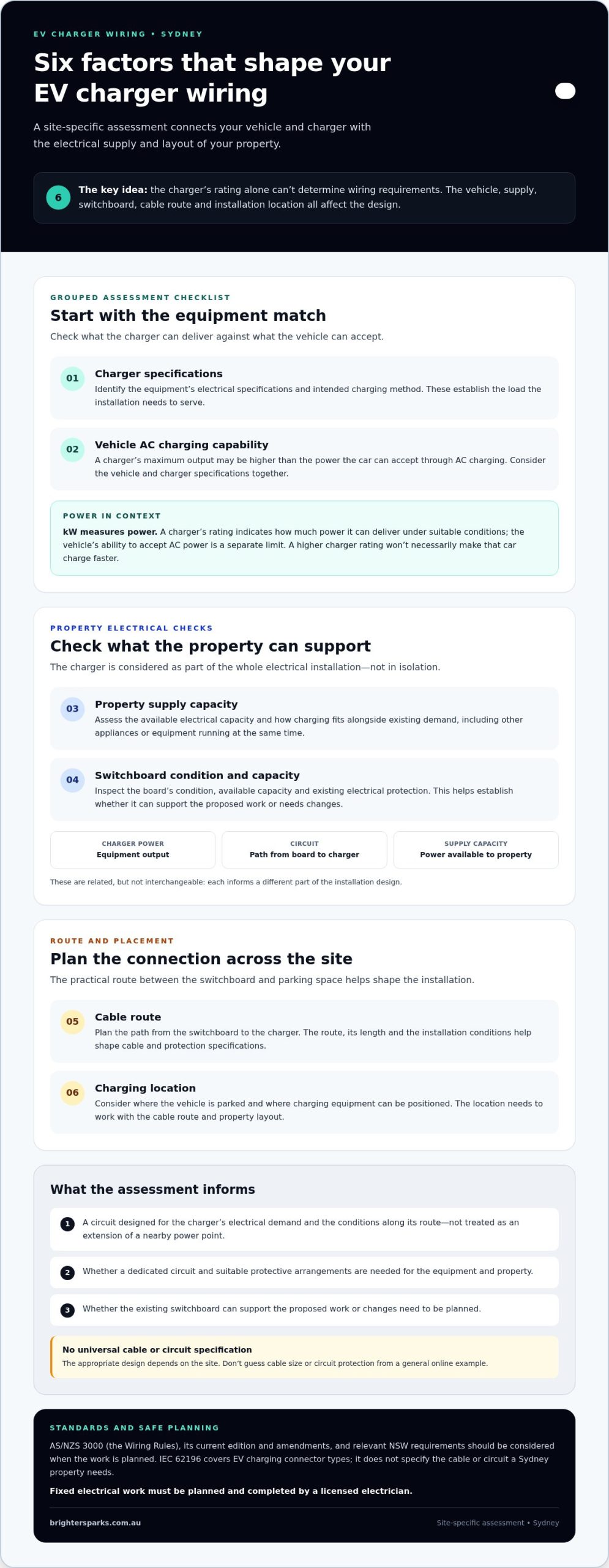
Three factors are related, but not interchangeable. Charger power describes how much power the equipment can deliver. The circuit is the electrical path between the switchboard and charger. Supply capacity is the power available to the property as a whole, including other appliances and equipment running at the same time.
A charger that suits one home may need a different wiring approach at another. The electrician considers the charger’s specifications, the distance from the switchboard to the parking space, the cable route, and the condition and capacity of the existing installation. This guide covers those planning factors, not universal cable or breaker sizes. The appropriate design depends on the site.
What is an EV charger circuit?
An EV charger circuit connects the switchboard to the charging equipment. It needs to be designed for the charger’s electrical demand and the conditions along its route, rather than treated as an extension of a nearby power point.
A dedicated circuit serves the charger separately from ordinary household circuits. This helps manage the charging load without relying on a general-use circuit that may also supply other appliances. The electrician determines the circuit and protective arrangements for the equipment and property. Don’t guess cable size or circuit protection from a general online example.
Which Australian rules and standards are relevant?
AS/NZS 3000, commonly known as the Wiring Rules, is a key reference for electrical installations in Australia. Its current edition, amendments and relevance to a particular EV charger installation should be verified when the work is planned. NSW requirements and the circumstances of the installation also matter, including the property’s existing wiring and supply arrangements.
Connector compatibility is another part of planning, but it isn’t the same as designing the electrical circuit. For background on connector types, see the IEC 62196 standard for EV charging connectors. The connector standard describes the connection between charging equipment and a vehicle; it doesn’t specify what cable or circuit a Sydney property needs.
Western Australian supply guidance shouldn’t be applied as a rule for a Sydney home. Local supply arrangements can differ, so a property assessment is the practical way to establish what the installation requires. Fixed electrical work should be planned and completed by a licensed electrician familiar with applicable NSW requirements.
How do electricians assess wiring, charger power and electrical load?
A useful assessment follows the proposed installation from the car back to the property supply. This connects the charger’s capabilities with what your vehicle can accept and what the site can safely support. A charger’s rating alone can’t determine the wiring requirements; the vehicle, supply, switchboard, cable route and installation location all affect the design.
An electrician will generally assess these factors:
- Charger: Identify the equipment’s electrical specifications and intended charging method. These details establish the load the installation needs to serve.
- Vehicle: Consider the vehicle’s AC charging capability. A charger’s maximum output may be higher than the power the car can accept through AC charging, so the vehicle affects how useful that rating is.
- Supply: Assess the property’s available electrical capacity and how charging fits alongside existing demand. The charger needs to be considered as part of the whole installation.
- Switchboard: Inspect its condition, available capacity and existing electrical protection. This helps determine whether the board can support the proposed work or needs changes.
- Cable route: Plan the path between the switchboard and charger. The route, its length and the installation conditions help shape cable and protection specifications.
- Location: Consider where the vehicle is parked and where the charging equipment can be positioned. The location needs to work with the cable route and property layout.
How does charger power affect the wiring assessment?
Kilowatts (kW) measure power. A charger’s rating indicates how much power it can deliver under suitable conditions, while the vehicle’s ability to accept AC power is a separate limit. If a vehicle accepts less AC power than the charger can provide, the higher charger rating won’t necessarily make that car charge faster. Consider the vehicle and charger specifications together.
What does the electrician inspect at the property?
The inspection connects the equipment plan with the site. The electrician considers the switchboard’s condition and capacity, existing protection, the proposed charging position and the practical cable route. They also account for household or business loads that may run while the vehicle is charging. Mention planned electrical upgrades, such as solar or battery installation, during the assessment.
For example, a household that regularly uses several high-demand appliances at the same time has a different overall load profile from one with fewer simultaneous demands. That context helps the electrician assess capacity and suitable protective devices. Cable and protection specifications should match the actual charger, supply and site conditions, not a generic diagram.
For Sydney homes and businesses, a site assessment turns these factors into an installation plan. EV charger installation in Sydney can include evaluating the property’s wiring and capacity before the installation approach is set.
Does an existing switchboard or power supply rule out an EV charger?
An older switchboard or a busy household supply doesn’t automatically mean an EV charger can’t be installed. Equally, don’t assume the existing setup will support charging without changes. The answer depends on the switchboard, available capacity, existing electrical protection and the property’s expected demand.
EV charger electrical wiring requirements are specific to the site. An electrician may find that the existing arrangement can support the planned installation, that charging needs to be managed alongside other loads, or that electrical upgrades are needed. These are possible outcomes, not steps every property must follow.
A switchboard assessment looks beyond whether there appears to be room for another circuit. The board’s condition, capacity and existing protection matter, as does the electrical supply serving the property. The electrician also considers the charger’s intended load and how it may coincide with other household or business demand.
When might a switchboard or supply upgrade be considered?
An upgrade may be considered if an inspection finds limited capacity, an unsuitable switchboard or existing equipment that needs attention before a new charger circuit can be added. The recommendation should follow an assessment of the board and property load, not an assumption based on the home’s age or charger type. There’s no single threshold that determines the answer for every Sydney property.
If an upgrade is recommended, the electrician can explain how it relates to the installation plan. A switchboard upgrade may address limitations at the board, while other work may relate to the property’s supply or wiring. The appropriate scope depends on the assessment.
Can charging be managed alongside other household loads?
Sometimes the question isn’t simply whether the property can support charging, but how charging should fit around other electrical demand. Load management considers the charger alongside equipment such as cooking appliances, heating or cooling, and other significant loads. This helps plan charging as part of the property’s overall electrical use.
Depending on the charger, wiring and site assessment, options may include controlling charging dynamically in response to household demand or scheduling charging for particular times. These are design possibilities, not automatic features of every charger or a substitute for checking the installation. The electrician needs to establish whether the equipment and property suit the proposed approach.
Share how the property is used, including which appliances commonly operate together and any planned electrical upgrades. That context helps the electrician assess realistic demand. The assessment can then establish whether the existing setup is suitable, load management is appropriate, or an upgrade should be included in the EV charger installation plan.
What should you prepare before EV charger wiring begins?
A little preparation makes an EV charger site assessment more useful. Have your vehicle’s charging details, usual parking position, preferred charger location, major electrical loads and any planned solar, battery or other electrical work ready. These details help the electrician understand how charging needs to fit the property.
What information helps plan a site assessment?
Check the vehicle manual or manufacturer materials for its AC charging information, and note the make and model. You don’t need to interpret the technical details yourself; having them available helps the electrician consider the vehicle alongside the charger. Also note where the vehicle usually parks, where you’d prefer the charger and where the switchboard is located.
Make a note of major household loads and which appliances are often used together. Include existing solar or a battery, and mention any upcoming installation or electrical upgrade. If you’re planning solar alongside charging, consider the timing and scope of both projects so the property’s electrical setup can be assessed as a whole.
- Vehicle: Make, model and charging information from the manual or manufacturer.
- Parking: The usual position of the vehicle and any likely changes to how you park.
- Charger location: Your preferred position and practical constraints around the parking area.
- Electrical setup: The switchboard location, major household loads and existing solar or battery equipment.
- Future work: Planned solar, battery or other electrical upgrades that could affect the installation plan.
With these details, the electrician can assess the site and work out a suitable wiring route and installation scope. The best route depends on the property layout, the distance between the switchboard and charger, and the conditions along the way. Your preferred location is a helpful starting point, but the assessment determines how it can be connected safely.
What happens during installation and final checks?
Once the approach is established, installation involves fitting the wiring and circuit for the site, connecting the charging equipment and checking the completed work. The route and installation details are property-specific, so there isn’t one standard layout for every home or business.
A licensed electrical professional completes the relevant testing and verification. This checks the wiring, connections and equipment as part of the completed work. Don’t attempt to install or alter fixed wiring yourself. Leave the electrical work and checks to a licensed professional.
For a Sydney property, having the vehicle details and site priorities ready helps Brighter Sparks Electrical Pty Ltd plan an EV charger installation around your wiring and electrical setup. Arrange an EV charger assessment to discuss the project and practical next step.
How Brighter Sparks plans EV charger wiring across Sydney
Brighter Sparks Electrical Pty Ltd installs EV chargers for homes and businesses across Sydney. Each installation starts with the property, not a standard wiring template. The charger, parking area, existing wiring and electrical capacity all help determine a suitable approach.
Two properties choosing similar charging equipment can have different installation needs. The switchboard might be close to the parking space in one home, while another site may need a longer or less direct cable route. Existing electrical infrastructure and how the property is used also shape the plan. The EV charger electrical wiring requirements are determined for the individual site, not assumed from the charger rating alone.
How a property-specific installation plan takes shape
The assessment brings together the intended charger position, wiring route and existing electrical infrastructure. Brighter Sparks considers how the vehicle will be parked and charged, where the switchboard is located, and how the connection can be planned for that layout. The installation approach is tailored to the site and charging needs, with technical specifications determined for the property.
If the assessment identifies a limitation in the wiring or switchboard, electrical wiring or a switchboard upgrade can be considered as part of the installation plan. That work isn’t assumed for every property. The recommendation follows the assessment, keeping the proposed scope connected to the site’s actual requirements.
Homes and businesses can have different priorities. A household may want the charger positioned to suit its regular parking arrangement, while a business may need to consider how vehicles use the site. Discussing the intended use helps inform the location and installation plan. Existing or planned solar and battery work is also useful context for broader energy planning.
What is the next step for Sydney property owners?
Before discussing an installation, gather the vehicle’s charging information, note its usual parking position and identify where the switchboard is located. It’s also helpful to describe major electrical loads, existing solar or battery equipment, and upcoming electrical work. These details give the conversation a practical starting point; the site assessment helps shape the plan.
There’s no need to select cable sizes or decide whether a switchboard upgrade is required before the property is assessed. Those technical decisions depend on the charger and the electrical setup at the site. Brighter Sparks Electrical Pty Ltd can discuss the proposed installation for your Sydney home or business and plan the work around the property’s wiring and capacity.
For a site-specific starting point, request an EV charger installation discussion with Brighter Sparks Electrical Pty Ltd.
Plan your next step with confidence
Before choosing an installation approach, consider how your charging plans fit with the way you use your property now and any electrical work you may plan for later. That context makes a conversation about EV charger electrical wiring requirements more useful, without expecting you to decide on technical details yourself.
Brighter Sparks Electrical Pty Ltd installs EV chargers for Sydney homes and businesses, with electrical wiring and switchboard upgrades available where the property assessment shows they’re relevant. The installation is planned around the site, rather than a standard solution.
If you’re ready to explore charging at home or work, share your plans and arrange a discussion about the property. Discuss an EV charger installation for your Sydney property.
A clear, property-specific plan is a practical first step towards charging that suits your needs.
Frequently Asked Questions
Does an EV charger need its own circuit?
Generally, a fixed EV charger needs a dedicated circuit rather than sharing a general household circuit. Its circuit and protective arrangements are selected for the charger’s electrical demand and installation conditions. A garage outlet circuit already used for lights or tools isn’t a substitute for a properly planned charger circuit. An electrician can assess the property and determine the right arrangement for your Sydney home or business.
Can I install an EV charger on a single-phase supply?
Yes, a single-phase supply can support an EV charger if the charger, vehicle and property suit the proposed setup. The vehicle’s AC charging limit can affect how much of the charger’s output is useful. The electrician also considers the supply’s available capacity and other electrical demand. A three-phase supply isn’t automatically required; the site assessment determines a practical approach.
Does an EV charger always need a switchboard upgrade?
No. An upgrade isn’t automatically needed just because you’re adding an EV charger. A switchboard that looks modern may still need its capacity and protection assessed, while an older-looking board isn’t proof by appearance alone that replacement is required. The electrician’s inspection and load assessment establish whether the existing board can accommodate the work or whether an upgrade should be considered.
What cable size is required for an EV charger?
There isn’t one cable size that suits every charger installation. The electrician determines the cable specification from factors such as the charger’s electrical requirements, circuit design, cable route and installation method. A cable size copied from another property may not suit yours, even if the charger appears similar. Have the actual site assessed rather than selecting cable or protection based on a general guide.
Can I use a regular power point instead of dedicated EV charger wiring?
Some vehicles can be charged using a portable lead designed for connection to a standard outlet, but that doesn’t mean every household power point is suitable for regular charging. The lead, outlet and circuit need to suit the intended use and condition. A fixed EV charger is a different installation and requires its own planned circuit. Don’t use an extension lead or adapt equipment to bypass an assessment.
Does solar change the wiring requirements for an EV charger?
Solar doesn’t remove the need to assess the EV charger’s circuit and the property’s electrical setup. It can affect how you want to coordinate charging with energy generated at home, so tell the electrician if solar or a battery is already installed or planned. For example, a household hoping to charge when solar generation is available can have its charging plan considered alongside its energy equipment and electrical demand.
Who can install EV charger wiring in NSW?
A licensed electrician should carry out fixed EV charger wiring in NSW. This work connects charging equipment to the property’s electrical installation, so it isn’t a DIY task or work for an unlicensed person. A licensed electrician can assess the switchboard, supply and proposed charger location, then complete the installation and relevant checks. For Sydney property owners, use a properly licensed professional for fixed electrical work.