The battery with the biggest capacity may not be the right fit for your home. Choosing well isn’t just about comparing kilowatt-hour figures. If you’re wondering how to choose a solar battery, start with how much energy your household uses after sunset and what you want the battery to do.
Battery specifications can be confusing. Capacity is a useful starting point, but it doesn’t tell the whole story: your solar system needs to be able to charge the battery, and the system must suit your home’s electrical setup and daily habits.
This guide explains which features matter and how to build a shortlist around your household’s energy use, existing or planned solar, and priorities, such as using more of your own solar power or having backup capacity. It also covers compatibility and installation considerations for a professionally installed system. Brighter Sparks Electrical supplies and installs solar battery systems across Sydney, with options tailored to the property and its solar setup.
Key Takeaways
- Learn how to choose a solar battery by weighing usable capacity against your household’s energy needs and priorities.
- Understand the difference between kWh, which measures stored energy, and kW, which describes how quickly power can be delivered.
- Compare batteries on more than capacity, including output, solar system compatibility, warranty terms and monitoring features.
- Use a practical shortlist process to review your usage, system fit and installation requirements before deciding.
- See how a professional assessment can bring your solar equipment and electrical infrastructure together when planning battery installation in Sydney.
How to choose a solar battery: start with your needs
A suitable battery should match three things: how your household uses electricity, how much solar your system can generate, and what you want the battery to achieve. Start with those basics before comparing models. A solar battery stores electricity for later use. Depending on the system, it can store surplus solar generation or electricity supplied from the grid.
The principle is similar to larger-scale storage, such as a Battery storage power station, but a home battery is selected for the needs and equipment of one property. It might help make more daytime solar available after sunset, provide backup during an outage, or support a broader goal of relying less on grid electricity. Those aims can call for different system choices.
Usable capacity is the amount of stored energy a battery can make available to your home. It matters more than headline capacity alone because the full stated capacity may not all be available for household use. When estimating how much of your regular consumption a battery could cover, focus on usable energy, then compare it with your solar generation and priorities.
Decide whether bill management or backup matters most
If bill management is the priority, the aim is generally to store surplus solar produced during the day and use it later, rather than drawing as much electricity from the grid. Backup is a separate requirement. A battery doesn’t automatically keep the whole home running during a power cut: backup depends on the system’s configuration and what it’s set up to supply. Before comparing products, rank bill management, backup and energy independence in order of importance. For example, note whether you mainly want to shift daytime solar into the evening or keep selected circuits supplied during an outage. That gives you a clearer basis for comparing system options.
Map your household’s electricity use
Use recent electricity bills and any available usage data to understand when your home draws power, not just how much it uses overall. Look for regular evening and overnight loads, such as cooking, heating or cooling, and compare them with daytime use. A family that uses most electricity after work may have different storage needs from a home that uses more during the day.
Allow for change, too. Seasonal routines can shift energy use as heating or cooling needs change, and planned additions such as an electric vehicle or a heat pump may alter future demand. Note what your home uses now and what you expect to change. This gives you a more useful starting point than choosing a capacity based on household size alone.
Before comparing product specifications, write down your main goal and the times your household uses the most electricity. These details help turn battery figures into a shortlist that reflects how your home actually runs.
Understand solar battery capacity, power and system compatibility
Battery specifications describe two different things: how much energy can be stored and how quickly it can be delivered. Both affect whether a system can support your household’s needs. As you work out how to choose a solar battery, compare the figures with your electricity use and the equipment already connected to your solar system.
Read capacity and power specifications correctly
Kilowatt-hours (kWh) measure energy stored; kilowatts (kW) measure the rate electricity is delivered. Think of kWh as the amount in a tank and kW as the rate it can flow out. For a simple illustration, a 2kW appliance running for half an hour uses 1kWh of energy. The battery needs enough usable energy for the duration of use, as well as sufficient output to run the appliance at that moment.
Nominal capacity is the battery’s stated total storage, while usable capacity is the portion available for household use. These figures aren’t necessarily the same, and usable capacity varies between systems. Compare the usable figure in the specifications rather than assuming headline capacity tells you exactly how much energy you can draw.
Power output matters if several appliances run at once. A battery may have enough stored energy for the evening but still be unable to supply the combined demand of larger loads running simultaneously. Check the continuous output specification and consider which appliances you expect to use together. There’s no single capacity or output that suits every home; the right comparison depends on your usage and intended role for the battery.
Check the battery against your solar and electrical setup
Compatibility depends on how the battery works with the inverter and solar system, not just on its own specifications. A battery is only a suitable match when its operation, inverter and solar system are compatible as a complete setup. Your existing inverter type and system configuration can affect which battery options are appropriate, so assess the equipment as a whole before settling on a model.
Grid-connected homes and off-grid properties can have different system requirements. A grid-connected battery is added to a home that remains connected to the electricity network; an off-grid system needs to support a property without that connection. The battery choice should reflect the role it must play in that setup, rather than treating the two arrangements as interchangeable.
Installation planning matters, too. The switchboard and wider electrical infrastructure form part of the assessment, particularly if equipment needs to be updated or connected differently. This doesn’t mean there’s a problem with your existing setup. It means the installation should account for the property’s actual equipment and layout.
For a home in Sydney, a professional assessment can bring the battery, solar equipment and electrical infrastructure into one plan. Brighter Sparks Electrical supplies and installs solar battery systems across Sydney. Explore solar battery supply and installation as part of planning a system tailored to your property.
Compare solar batteries using criteria that matter beyond capacity
Once you’ve identified suitable capacity and system fit, compare the details that affect day-to-day operation and long-term suitability. A clear, like-for-like comparison shows where products differ without assuming the biggest capacity or longest warranty is automatically the best choice. As you decide how to choose a solar battery, use the same criteria for each option and refer to the manufacturer’s documentation for the exact model.
A comparison table can keep the information easy to scan. Include these fields:
- Usable capacity: Record the energy available for household use, not just the stated total capacity.
- Continuous output: Note the power the battery can supply steadily, then consider whether it aligns with the appliances you expect to run at the same time.
- Compatibility: Check how the battery works with the inverter and solar system in your home.
- Warranty terms: Compare duration, capacity retention conditions and any throughput limits separately.
- Monitoring: Note what information the system provides so you can see how it operates and whether that information is useful to your household.
Use equivalent figures wherever possible. For example, don’t compare one battery’s usable capacity with another’s nominal capacity, or treat output ratings as interchangeable if they describe different operating conditions. If a specification is unclear, keep it on your list of points to clarify during installation planning rather than filling the gap with an assumption.
Compare operating limits, efficiency and warranty terms
Round-trip efficiency describes how much energy you can get back compared with the amount stored. Some energy is lost during charging and discharging, so this figure helps you understand how efficiently a battery moves energy through a full cycle. Read it alongside the manufacturer’s stated operating conditions and performance limits, which explain the circumstances the figures relate to.
Separate warranty details into distinct questions. How long does the warranty run? What capacity retention does it cover, and under what conditions? Are there throughput limits that affect coverage? Duration alone doesn’t establish expected performance or suitability. Read the actual terms for the model rather than relying on a headline warranty period.
Check monitoring, expansion and backup functions
Monitoring can help you observe battery activity and energy flows, depending on what the system reports. Decide which information would help you understand your household’s use. Treat expandability as a feature only if the specific system documentation confirms it, including any stated limits or conditions.
Backup is distinct from normal grid-connected operation. A battery may store energy for later use without supplying the home during an outage. Backup capability depends on system configuration and the circuits intended to receive power. Compare this function if it’s a priority, and assess the documented setup rather than assuming battery ownership provides whole-home backup.
No single battery is best for every home. A careful comparison links each specification to your priorities, solar equipment and household use, then highlights the details to address in the installation plan.
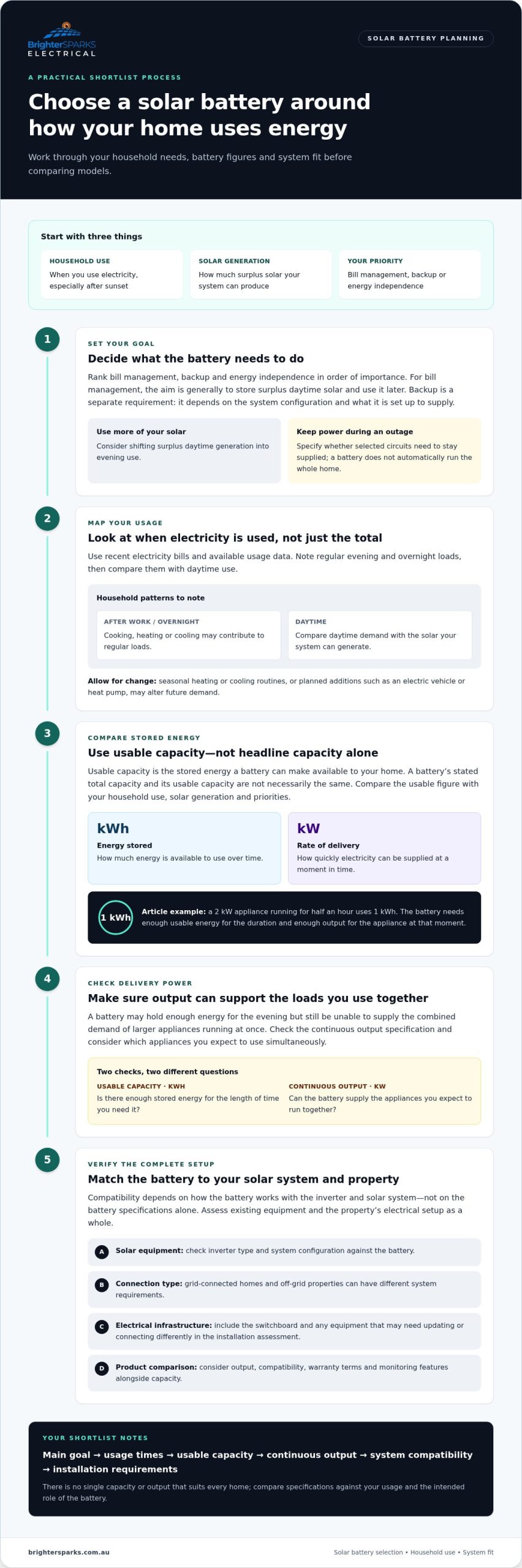
Use a practical checklist to shortlist the right solar battery
Turn your research into a shortlist before focusing on particular models. The process below keeps household priorities, product information and installation requirements in view. It’s a practical way to work out how to choose a solar battery without trying to settle every technical detail from a specification sheet.
Build a shortlist from your household data
Gather recent electricity bills, details of your solar system and any available consumption data. Note when your household uses the most power, and whether backup is essential, desirable or not a priority. For Sydney homes, routines vary with work and school schedules, heating or cooling use, and time spent at home. Base your notes on your own pattern rather than a typical household.
- Define your priorities. Rank bill management, backup and energy independence. Be specific about what you expect the battery to do, such as storing daytime solar for evening use or supplying selected household needs during an outage.
- Review your usage. Use bills and available data to identify regular consumption periods and notable seasonal changes. Include planned additions that could affect electricity use, rather than sizing around today’s routine alone.
- Check system fit. Record the solar equipment and inverter details you have. Treat compatibility as a whole-system question, not a box-ticking exercise based on the battery model alone.
- Compare product terms. Put comparable usable capacity, output, warranty conditions and other relevant specifications side by side. Use the manufacturer’s documentation to understand what each figure and term covers.
- Assess installation needs. Include the property, existing equipment and your priorities in a site-specific assessment of the system configuration and electrical requirements.
Keep battery sizing at a high level while you shortlist. Avoid choosing a capacity solely from household size or a general rule of thumb. For detailed capacity calculations, use the dedicated solar battery sizing guide when available, then bring your usage information into the installation assessment.
Know which details need a site-specific assessment
A product table can help you compare published specifications, but it can’t show how a proposed battery will work with the home’s actual solar configuration, inverter and electrical infrastructure. A site-specific assessment connects those details with your priorities and can identify whether the switchboard or other electrical work needs consideration. This isn’t an assumption that something is wrong; it’s part of planning a suitable installation.
Quick checklist: You can gather bills, usage patterns, solar details and product terms yourself. A qualified installation assessment evaluates system compatibility, electrical infrastructure and how the proposed setup fits the property.
Sydney homeowners planning a battery can discuss a tailored solar battery installation with Brighter Sparks Electrical, bringing household needs and existing solar equipment into the conversation.
Plan solar battery supply and installation with a Sydney electrical team
Product research helps narrow your options, but the final system needs to suit the property as well as the household. A professional assessment brings your priorities, electricity-use information, solar equipment and electrical infrastructure together. It turns your shortlist into a practical proposal based on the home’s existing setup and the role you want the battery to play.
What a tailored battery proposal should address
A useful proposal should show how the recommended system relates to your household usage and stated priorities. For example, if your focus is using more stored solar after sunset, the proposal should explain how the system is intended to support that use. If backup is a priority, it should describe the proposed configuration and what it is designed to supply, rather than implying that every battery provides the same backup function.
Equipment compatibility and site conditions also shape the design. The assessment should consider your solar system and inverter, along with the property’s electrical infrastructure and installation requirements. This is where a product comparison becomes a site-specific plan.
As you review the proposal, look for clear information about:
- System design: How the proposed battery fits your solar equipment and household priorities.
- Operating limits: The documented capacity, power output and any relevant conditions on operation.
- Installation inclusions: The work included in the proposed supply and installation, and any electrical work identified for the property.
- Warranty documents: The applicable manufacturer terms, including what the coverage addresses and any stated conditions.
If you’re considering an incentive, treat eligibility as a separate item to verify against current programme requirements and the proposed system. Don’t assume that a battery model or installation automatically qualifies.
Take the next step in Sydney
Before discussing installation, bring together your intended use, recent household data, existing solar and inverter details, and comparison notes. This gives the assessment a practical starting point and keeps the conversation focused on what matters to your home. Keep your shortlist flexible until system compatibility and site requirements have been considered.
Brighter Sparks Electrical supplies and installs solar battery systems across Sydney. The team assesses how household priorities, solar equipment and electrical infrastructure fit together, then plans a system tailored to the property. This local supply and installation step builds on your research without relying on headline specifications alone.
If you’re ready to discuss your shortlist and installation needs, talk with Brighter Sparks about a solar battery system. A clear discussion of your intended use and existing setup is a practical next step in deciding how to choose a solar battery for your home.
Turn your shortlist into a system that fits
The next step isn’t to chase a perfect set of specifications. It’s to make a considered choice for the home you have, while keeping future changes in mind. As you decide how to choose a solar battery, focus on a proposal that connects your intended use with the equipment and installation needs of your property.
Brighter Sparks supplies and installs solar battery systems across Sydney, and also installs solar panels and tailored off-grid solar systems. If you’re weighing up a battery on its own or as part of a wider solar plan, a practical discussion can help move your research towards a system suited to your home.
Discuss a solar battery system for your Sydney home with Brighter Sparks. Bring your questions and priorities to take the next step with a clearer plan.
Frequently Asked Questions
How do I choose the right size solar battery for my home?
Choose a size based on the electricity you want to cover and when you use it, not simply the number of bedrooms. To work out how to choose a solar battery, review usage data alongside how much solar energy is typically left over to charge it. A household that uses power late into the evening may have different needs from one that uses most of its electricity during daylight. Allow for seasonal changes and planned appliances, too.
Is a solar battery worth it if I already have solar panels?
It may suit you if your panels often produce surplus electricity during the day and your household uses power after sunset. The value depends on how much energy you can store and use, your electricity plan, and the system’s purchase and installation costs. Compare the benefit of using stored solar with the value of exporting it to the grid. No battery can guarantee bill savings or a particular payback period.
Can I add a battery to my existing solar system?
Often, a battery can be added to an existing solar setup, but the available options depend on the inverter, system configuration and electrical infrastructure. For a Sydney home, have the existing equipment assessed before selecting a battery; a model that works with one setup may not suit another. Gather your solar system details and inverter information for the assessment. Consider the proposed connection and any required electrical work together.
What is the difference between solar battery capacity and power?
Capacity describes how much energy the battery can store, while power describes how quickly it can supply electricity. For example, a battery could hold enough energy for several hours of modest use, yet have a lower output limit that restricts how many high-demand appliances can run together. Check both specifications against the appliances you plan to use at the same time, rather than relying on capacity alone.
Will a solar battery keep my home running during a blackout?
Not necessarily. A battery designed for storing energy during normal operation may not supply electricity during a blackout. Backup depends on the system configuration, including which circuits are set up to receive power. If keeping particular equipment running matters, identify those appliances in advance and have the proposed backup arrangement explained. Don’t assume the whole home will stay powered or rely on an estimated duration without checking the system design.
How long does a solar battery last?
There isn’t one service life that applies to every battery. Longevity depends on the particular system, how it is used and its operating conditions. Read the manufacturer’s warranty for its duration, capacity-retention provisions and any usage or throughput conditions. These terms describe the coverage offered, not a promise that every battery will perform identically for that period. Keep the warranty documents with your installation records for future reference.
Are there NSW rebates for solar batteries in 2026?
Eligible battery installations may qualify for the Australian Government’s Cheaper Home Batteries Program. As of 2026, the rebate is delivered through Small-scale Technology Certificates, with the amount based on eligible usable capacity and tiered above 14 kWh. In NSW, an additional incentive may be available for connecting a battery to a Virtual Power Plant. Programme rules and eligibility can change, so check current requirements for your proposed system before relying on an incentive.