A bigger solar system isn’t automatically a better fit. A 10kw solar power system may suit a busy household with high electricity use, but its 10kW capacity doesn’t guarantee a set amount of daily generation or usable power at home.
When comparing systems, the key question is whether expected generation matches your household’s electricity use, the times you use power and what your property can support. Solar production varies with roof orientation, shading and weather. Network export limits can also affect how much unused energy goes back to the grid.
This guide explains what 10kW means, what it doesn’t promise and how to judge whether that size could suit your home. You’ll learn how to compare system capacity with your electricity use and daytime habits, and how roof, electrical and Sydney network conditions can shape the design. Use these factors to choose a system that fits your household, rather than selecting a size by name alone.
Key Takeaways
- A 10kw solar power system is rated by capacity. Compare that figure with expected generation in kilowatt-hours to understand what it may contribute over time.
- Using solar power while the panels are generating can reduce how much electricity your home draws from the grid.
- Look beyond annual electricity use. Daytime demand, roof space and future electrical loads all help determine a suitable system size.
- Before planning, gather recent power bills and consider roof orientation, shade, weather exposure and switchboard requirements.
- Brighter Sparks Electrical Pty Ltd can tailor solar panel designs to your property by considering energy use, site conditions and electrical requirements.
What Does a 10kW Solar Power System Actually Mean?
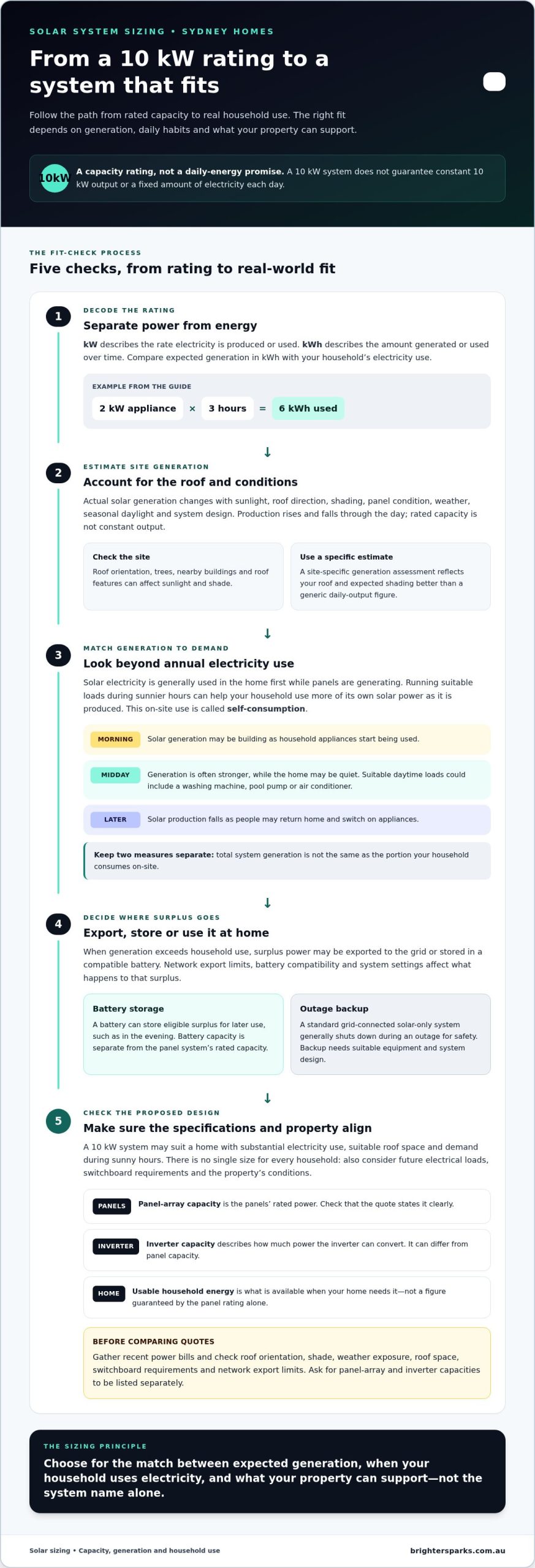
A 10kW solar power system has a rated capacity of 10 kilowatts. That rating describes the system’s power under specified test or operating conditions. It doesn’t promise constant 10kW output or a fixed amount of energy each day. The rating is power at a point in time, not the total electricity generated over several hours.
Think of kilowatts (kW) as the rate electricity is produced or used, and kilowatt-hours (kWh) as the amount used or generated over time. For example, an appliance drawing 2kW for three hours uses 6kWh. Solar generation is also measured in kWh, which makes it possible to compare production with your household’s electricity use.
These figures describe different parts of the system and home. Panel capacity is the panels’ rated power. Inverter capacity describes the equipment that converts their output into electricity for household use. Usable household energy is the power available when your home needs it. The components and how they work together form a photovoltaic system. A 10kW panel rating alone doesn’t tell you how much electricity will be available at a particular moment.
Does 10kW refer to the panels or the inverter?
System descriptions may refer to the panel array, the inverter, or both. These capacities can differ, so a quote should state each specification clearly rather than relying on the headline size. Panel capacity indicates the array’s rated output, while inverter capacity indicates how much power the inverter can convert. Neither figure means your home will receive that amount continuously.
Check that the proposed design lists panel-array capacity and inverter capacity separately. This makes system comparisons clearer and helps you understand what the quoted size represents.
What changes the energy a 10kW system produces?
Actual generation depends on sunlight reaching the panels, roof direction, shading, panel condition and system design. Trees, nearby buildings and roof features can cast shade, while weather and seasonal daylight affect the amount of available sun. Production also rises and falls through the day, so the system won’t operate at its rated level all the time.
For a useful estimate, look for a site-specific generation assessment that accounts for the roof and expected shading. A generic daily-output figure can’t reflect the conditions at your property. In Sydney, roof orientation and local shade vary between homes, so the same rated capacity can produce different results at different sites.
How Does a 10kW Solar System Work With Household Energy Use?
Solar electricity is generally used in your home first while the panels are generating. It can run appliances and other household loads at the time, such as a washing machine, pool pump or air conditioner. If generation exceeds what the home is using, surplus power may be exported to the grid or stored in a compatible battery.
Matching daytime electricity use to solar generation helps your household use more of its own power as it’s produced. This is called self-consumption. It differs from total system generation: panels might generate energy throughout the day, but your home consumes on-site only the portion used at the time. What happens to surplus depends on whether you have a battery and on your system’s settings and arrangements.
A 10kw solar power system generates electricity as household demand changes. A typical day can help illustrate how generation and use interact, though every household has its own routine.
How do generation and household demand line up?
In the morning, solar generation may be building as the household starts using appliances. Around midday, generation is often stronger, but the home may be quiet. Later, as solar production falls, people may return home and switch on appliances. Running suitable loads during sunnier hours can help a household use more solar directly. Total generation and the amount consumed on-site are separate measures.
For a Sydney property, use a site-specific design and generation estimate to understand how local conditions and your household’s routine may affect the match between production and demand.
What role can a battery play alongside a 10kW system?
A battery can store eligible surplus solar electricity for later use, such as in the evening when panels are producing less. Battery capacity describes how much energy it can store, which is separate from the panel system’s rated capacity. A larger solar array doesn’t automatically mean a particular battery size is right for your home.
Battery suitability depends on when you use electricity, how much surplus is available to store and what you want the battery to do. Backup during a grid outage is a separate design consideration. A standard grid-connected solar-only system generally shuts down during an outage for safety, so panels alone don’t normally keep household circuits running. Backup operation requires suitable equipment and system design.
To assess a solar and battery setup together, consider usage patterns, site conditions and electrical requirements. Brighter Sparks Electrical Pty Ltd supplies and installs solar panels and batteries across Sydney, with designs tailored to the property. Explore solar system options for your home to consider how generation, storage and household demand could work together.
Is a 10kW Solar Power System Too Large for Your Home?
There’s no single system size that suits every household. A 10kw solar power system could be a practical fit for a home with substantial electricity use, suitable roof space and demand during sunny hours. A lower-capacity system may better match a smaller household’s usage and site. The right choice depends on how much electricity you use, when you use it and what your property can support.
Annual consumption is a useful starting point, but it doesn’t show when your household uses power. Two homes with similar yearly bills may have different daytime routines, roof conditions and plans for future electrical loads. Review recent bills alongside planned changes, such as adding an electric vehicle charger or using more heating and cooling.
| System size to consider | Factors that may support it | What to assess |
|---|---|---|
| Smaller than 10kW | Lower consumption or limited suitable roof area | Daytime demand and the value of available export |
| 10kW | Higher electricity use or regular daytime loads | Roof suitability, usage patterns and future plans |
| Larger than 10kW | Substantial or growing demand and suitable site conditions | Whether the system can be used effectively and connected appropriately |
Which household patterns may suit a 10kW system?
Higher electricity use and regular daytime demand can make a 10kW system worth assessing. A pool pump, ducted air conditioning, an EV charger or a home office may contribute to daytime loads, but none automatically means you need this size. Compare recent bills with your actual routines, then include planned electrification so the design reflects current use and likely changes.
When might a smaller system be a better fit?
A smaller system may suit a home with modest consumption, little daytime use or limited unshaded roof area. Also consider how much surplus electricity could be exported and the network settings that apply to the connection. If export is constrained, extra generation may not deliver the value you expect. Review the property and usage before deciding that any option is oversized.
A larger system doesn’t automatically mean greater household savings. Its value depends partly on how much generation you use at home and on the arrangements for surplus power. If much of the output occurs when demand is low, the benefit may differ from that of a home that runs appliances during sunny hours.
Use the comparison as a starting point, not a fixed rule. A site-specific design can bring together bills, daytime habits, roof suitability and future loads to show whether a smaller, 10kW or larger system is a sensible match for your household.
What Should Sydney Homeowners Check Before Choosing a 10kW System?
A suitable system design depends on more than roof size or the number on an electricity bill. Before deciding on a 10kw solar power system, gather information about household energy use, roof conditions and the electrical setup. This gives the design a practical starting point and helps identify constraints early.
Use this pre-design checklist to organise the details:
- Recent electricity bills: Collect bills showing usage across different seasons. Note when people are usually home and which appliances run during the day.
- Usable roof area: Consider the roof sections that could realistically accommodate panels, rather than measuring the entire roof. Include roof features and areas that may not suit panel placement.
- Shade and exposure: Look for shade from trees, chimneys and neighbouring buildings. Note how sunlight and weather exposure vary around the property.
- Switchboard and meter: Record any known switchboard issues and the type of meter in place. These electrical details help inform the installation design.
- Future energy loads: List planned changes, such as an EV charger, a pool pump or increased heating and cooling use. The design should account for likely household changes as well as current bills.
How do roof space, orientation and shade affect the design?
Total roof size isn’t the same as usable panel space. Roof orientation, pitch, access, obstructions and shade all influence where panels can go and how the system may perform. Sydney homes can have different combinations of roof direction, surrounding trees and weather exposure, so there’s no single layout for every property.
A site assessment helps identify practical panel locations and supports a generation estimate based on the property, rather than a generic assumption about the roof.
Which household and network details belong in the assessment?
Alongside bills and roof details, include meter information, switchboard condition and planned electrical loads. Also identify whether your property is in an Ausgrid or Endeavour Energy network area. The relevant distribution network service provider (DNSP) can affect connection and export requirements, so current rules for the property should be considered before the design is finalised.
Network settings and applicable standards can change. Avoid relying on old export-limit figures or assumptions. The design should account for the current requirements that apply to the address and proposed system.
Brighter Sparks Electrical Pty Ltd can assess your roof, energy use and electrical requirements to plan a solar design around your Sydney property. Arrange a tailored solar assessment to discuss the site and your household’s needs.
How Can Brighter Sparks Help Plan a 10kW Solar Power System?
Choosing a solar system is a property-specific decision, not simply a matter of selecting a capacity from a catalogue. Brighter Sparks Electrical Pty Ltd supplies and installs solar panels across Sydney, with designs tailored to the home’s energy use, roof conditions and electrical requirements. This helps establish whether a 10kw solar power system fits your needs or whether another size is a better match.
Good planning brings the practical details together: how much electricity your household uses, when you use it, where panels can be positioned and whether the existing electrical infrastructure needs attention. If your goals include storing solar power for later or running an off-grid system, those needs can also inform the project design.
What does a tailored solar assessment consider?
A tailored assessment reviews recent electricity use alongside roof layout, orientation and shading. It also considers relevant electrical infrastructure, such as the switchboard and meter. These factors help shape panel placement and system design. Rather than assuming every home needs 10kW, the assessment matches the proposed capacity to the household and site. Any projected performance should reflect the property and proposed system, not a generic estimate.
Useful details to have ready include:
- Recent electricity bills covering different seasons, if available.
- Notes on when household members are home and which major loads run during the day.
- Roof features or nearby trees and buildings that may affect panel placement.
- Planned changes, such as an EV charger or increased heating and cooling use.
- Your priorities, including using solar directly, adding battery storage or considering off-grid power.
What is a practical next step for a Sydney homeowner?
Start by gathering your bills and writing down expected changes in energy use. This gives the design process a clearer picture of current demand and future plans. Brighter Sparks Electrical Pty Ltd installs solar panels and related electrical solutions across Sydney, including solar batteries and off-grid solar systems. The project can be planned around your goals, rather than treating a particular system size as the default.
A site-specific assessment brings together energy use, roof conditions and electrical requirements before you settle on a system size. It also gives you a clear basis for discussing how solar panels, battery storage or off-grid options could fit your household. Consider your property’s details before deciding on 10kW.
Ready to talk through your household’s needs? Discuss a solar system for your home with Brighter Sparks Electrical Pty Ltd.
Take the next step towards a solar design that fits
You don’t need to settle on a system size before starting a conversation. First, consider what you want your home’s energy setup to support over the coming years. That bigger picture puts a proposed 10kw solar power system into context and keeps the decision focused on your household, rather than the system label alone.
Bring your priorities and questions together, then discuss how they can inform a design for your property. Brighter Sparks Electrical can help you explore solar options, including battery storage or off-grid systems where they suit your goals. The aim is a considered plan, not a one-size-fits-all answer.
Plan your home’s solar system with Brighter Sparks and take a practical step towards an energy setup that suits your household.
Frequently Asked Questions
Is a 10kW solar system enough to run a house?
It may supply a substantial share of a home’s electricity, but it can’t guarantee full coverage. A 10kw solar power system’s contribution depends on generation, household demand and how much solar power you can use or store. For a practical check, compare your bills with the times you run energy-intensive appliances. A home that uses most of its power after sunset may rely on grid electricity more than one with similar usage during daylight.
Can a 10kW solar system keep my home running during a blackout?
Usually not on its own. A standard grid-connected solar system generally shuts down during a power outage, even in daylight. Backup operation requires suitable equipment and a system designed to provide it. If you want essential items to keep running, such as a fridge or selected lights, identify those circuits during system planning. Backup capability depends on the design, so don’t assume every circuit will operate during an outage.
Does a 10kW solar system need three-phase power?
Not automatically. The suitable configuration depends on your home’s electrical supply, the proposed equipment and the requirements that apply to its network connection. Check the supply type recorded for the property and include the electrical setup in the design assessment. This is especially useful if you’re planning other major loads, such as an EV charger, as they may affect how the home’s electrical needs are considered.
Can I add a battery to a 10kW solar system later?
Battery storage can often be considered after panels are installed, but compatibility depends on the existing inverter, system design and property requirements. If adding storage later is a possibility, raise it during the initial design so equipment choices can take that goal into account. A battery isn’t automatically needed with a 10kW system. Consider your evening electricity use and whether backup power is a priority.
What happens to excess power from a 10kW solar system?
After supplying your home’s immediate demand, surplus generation may be exported to the grid, depending on the connection arrangement and network settings. The value of exported electricity can differ from the price you pay to buy power, and retailer feed-in plans vary. Review the export assumptions in your system design and electricity plan. This helps you understand how surplus is handled instead of assuming every unused kilowatt-hour earns the same return.
Will a 10kW solar system work on cloudy days?
Yes, panels can still generate electricity in cloudy conditions, but output is generally lower than in strong sunlight. This can affect how much power is available for appliances at a particular time. If you’re planning household tasks around solar, allow for variable generation rather than expecting the same result each day. A site-specific estimate can help set realistic expectations across different weather and seasonal conditions.
Can a 10kW solar system charge an electric vehicle?
It can contribute to charging while the system is generating, but available solar power varies with household demand and conditions. If your vehicle is usually parked at home during the day, daytime charging may help you use more solar electricity directly. If it’s away during those hours, charging may draw more power from the grid unless other arrangements are in place. Include your usual driving and charging routine when planning solar and EV charging together.