Could a charger that suits your car still be the wrong fit for your home? Home EV charger installation Sydney homeowners can rely on depends on more than the vehicle: your electrical supply, switchboard, parking location and charging routine all matter. It’s understandable to feel unsure about what your property can support or which charger features are worth prioritising.
Start with the way you’ll charge day to day, then consider what your home needs to make installation practical and safe. This guide explains how to match a charger to your vehicle and household routine, what an electrical assessment considers, and how the installation plan can vary by property.
We’ll cover charger selection, your switchboard and power supply, and factors that can affect the work, including parking access and existing solar or battery plans. Brighter Sparks Electrical installs home EV chargers across Sydney and can carry out relevant electrical upgrades as part of a project. By the end, you’ll know which details to gather before discussing your installation.
Key Takeaways
- A dedicated home charger can make regular EV charging more convenient than relying on public chargers for everyday top-ups.
- For home EV charger installation Sydney, a site assessment helps determine the charger location, cable route and installation scope.
- Compare chargers with your vehicle’s compatibility and onboard AC charging capability, then consider which features suit your routine.
- Gather details about your car, parking space, property access and electrical setup to make planning and quoting more straightforward.
- Brighter Sparks Electrical plans home EV charger installation around your vehicle, home and site conditions, considering relevant electrical or solar work as part of the project.
Home EV charger installation in Sydney: when a dedicated charger makes sense
A home EV charger installation involves fitting a dedicated charging unit at a residence and connecting it safely to the home’s electrical supply. The charger is the equipment; installation includes assessing the site, planning the work and connecting the unit. In short, a home charger is the unit, while installation is the work that makes it part of your home’s electrical setup.
Charging at home lets you top up while the car is parked, rather than planning regular trips around public charging locations. This can suit a predictable routine, particularly if your vehicle stays at home overnight. Public chargers can still be useful for longer journeys or when you need a top-up away from home. The main types of EV charging stations include AC and DC infrastructure, which serve different charging situations.
Is a dedicated home charger right for your Sydney household?
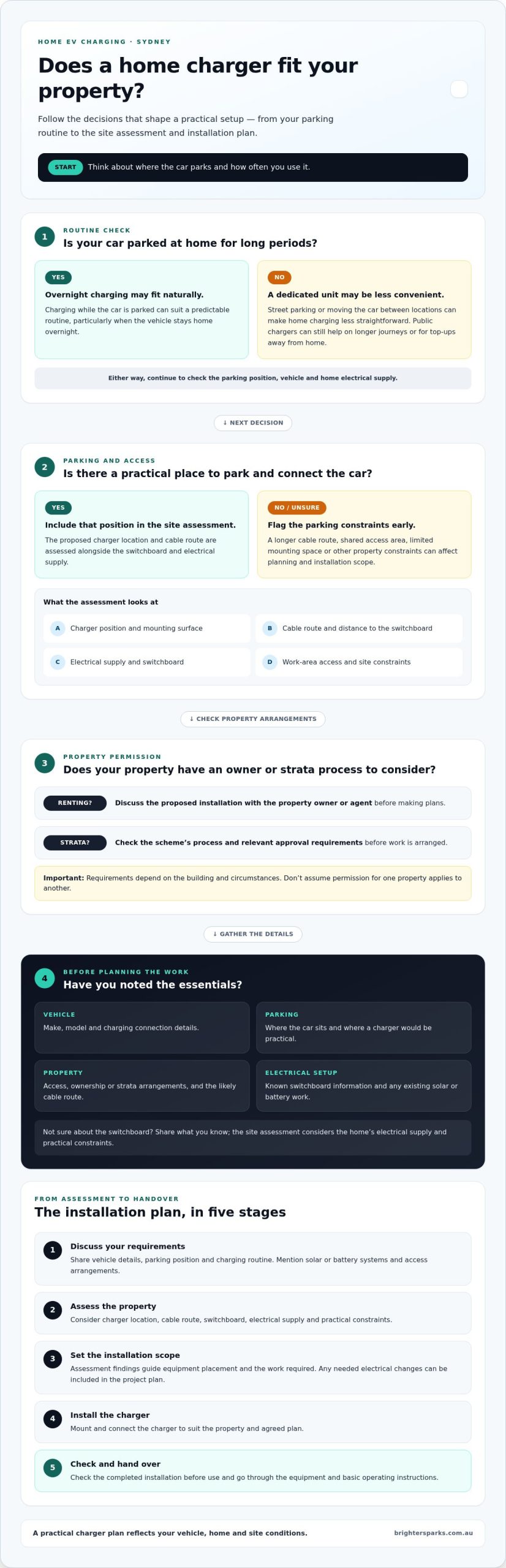
Start with two practical questions: where does the car usually park, and how often do you use it? If it’s parked at home for long periods, overnight charging may fit naturally into your routine. If you rely on street parking or move the car between locations, a dedicated unit may be less convenient. Your vehicle and the home’s electrical supply also affect which setup will work for you.
What can affect installation at a Sydney property?
The switchboard’s condition and the distance to the planned charger location can affect the work involved. The cable route matters too: a clear, direct path presents different considerations from a route around walls or through other parts of the property. A site assessment helps identify a suitable location and define the practical installation scope before work is planned.
Property type also affects planning. A detached home may offer more flexibility in choosing a charger position, while a townhouse could have a shared wall, limited parking area or longer cable route to consider. Apartments may involve shared areas or building infrastructure, so planning can be more involved than at a standalone house.
If you rent, discuss the proposed installation with the property owner or agent before making plans. In a strata property, check the scheme’s process and any relevant approval requirements before work is arranged. Requirements depend on the building and circumstances, so don’t assume permission for one property applies to another. Brighter Sparks Electrical installs home EV chargers across Sydney, with each project planned around the vehicle, parking arrangement and site conditions.
- Vehicle: Note the make, model and charging connection details.
- Parking: Identify where the car sits and where a charger would be practical.
- Property: Consider access, ownership or strata arrangements, and the likely cable route.
- Electrical setup: Share any known information about the switchboard and existing solar or battery work.
These details help frame the initial discussion. Next, compare charger options with your car’s charging capability and household routine, then consider what the property can support.
What happens during a home EV charger installation in Sydney?
A clear installation plan starts with your charging needs and the physical layout of your property. For home EV charger installation Sydney, Brighter Sparks Electrical plans the project around your vehicle, parking position and electrical setup, so the proposed work reflects the actual site rather than assumptions.
A site assessment turns your parking arrangement, electrical setup and charging needs into a practical plan for the charger position, cable route and installation scope.
- Discuss your requirements. Share your vehicle details, where it parks and how you expect to charge. Mention existing solar or battery systems and any access arrangements that could affect the site visit.
- Assess the property. The site assessment considers the proposed charger location, cable route, switchboard, electrical supply and practical constraints.
- Set the installation scope. The findings guide equipment placement and the work required. If electrical changes are needed, they can be included in the project plan.
- Install the charger. The work follows the agreed plan, with the charger mounted and connected to suit the property.
- Check and hand over. The completed installation is checked before use, and you can go through the equipment and basic operating instructions.
What does a home EV charger site assessment consider?
The assessment considers where the car is usually parked and whether the proposed charger position is practical for connecting it. The cable route is assessed alongside the switchboard and the home’s electrical supply, so the installation scope reflects the site. Access to the work area, the mounting surface and property-specific constraints matter too. Clear photos and notes about parking or access can make the initial discussion more useful.
For example, a charger beside a garage may need a different cable route from one planned for a driveway farther from the switchboard. A shared access area, limited mounting space or strata arrangements can also affect planning. The aim is to identify these details early, rather than assume every home needs the same setup.
What happens on installation day and at handover?
The installer follows the agreed scope. Depending on the site, the work may involve preparing the mounting position, routing and connecting electrical cabling, and fitting the charging unit. The sequence and any disruption depend on the property and work required, so a fixed time estimate isn’t useful until the scope is clear.
Before using the charger, make sure the completed installation has been checked and that you understand the basic operating steps. Ask for a walk-through of the equipment, including how to begin and stop charging and any instructions specific to your setup. Keep the information accessible for other household members who may use the charger.
Vehicle details, a photo of the parking area and any known switchboard information can help make the assessment more productive. Explore home EV charger installation with Brighter Sparks Electrical for a project planned around your home and charging routine.
How to compare home EV chargers for your car and Sydney property
A suitable charger works with your vehicle, fits your parking setup and supports the way you charge. Don’t choose by headline power rating alone. The car’s onboard charger, the home’s electrical supply and the installation conditions all affect what the system can deliver. Use this comparison to narrow your options before arranging home EV charger installation Sydney.
| What to compare | What to check | Why it matters |
|---|---|---|
| Vehicle compatibility | Charging connector and the vehicle maker’s stated AC charging capability | The car’s onboard charger can limit the AC charging rate, even if the home unit is capable of more. |
| Charging routine | Typical daily travel, time parked at home and when you prefer to charge | A regular overnight parking window may meet your needs without prioritising the highest available rating. |
| Installation fit | Parking position, cable reach, mounting location and electrical supply | A charger needs to be practical to use and suited to the property’s site conditions. |
| Connection style | Fixed cable or a socket-based unit | A fixed cable is ready to connect, while a socket-based arrangement lets you use a separate compatible cable. Consider storage and everyday handling. |
| Useful functions | Access control, scheduling, monitoring or solar compatibility, if supported | Choose functions that suit your household and energy setup, rather than prioritising features you’re unlikely to use. |
Match charger capability to your EV and daily routine
Start with the vehicle maker’s charging specifications, including its maximum AC charging capability and connector requirements. A charger with a higher rating won’t automatically charge your car faster if the vehicle can’t accept that level of AC power. Your available electrical supply and installation conditions matter as well, so consider the car and the property before settling on a rating.
Then think about how much you drive and how long the car is normally parked at home. A household with a predictable overnight parking routine may have different needs from one where the car is home only briefly between trips. Compare options with your usual pattern in mind, not an occasional day with unusually high travel.
Which charger features matter at home?
Scheduling can be useful if you want charging to follow a particular household routine or electricity plan. Access control may suit a shared parking arrangement, while monitoring can help you keep track of charging activity. These functions depend on the unit, so compare its stated features with what you’ll actually use.
Check solar compatibility separately if your home has rooftop solar. Don’t assume a charger can coordinate with your solar system simply because it’s described as smart. Confirm compatibility with the relevant equipment and consider whether the feature suits your charging habits. Brighter Sparks Electrical plans charger selection and installation around your vehicle, home and site assessment.
Prepare for your Sydney home EV charger quote and installation
Gathering a few details before requesting a quote can make the discussion more useful. They give the installer an early picture of your vehicle, parking arrangement and property, while a site assessment clarifies the work involved. For home EV charger installation Sydney, the scope may be affected by the distance from the switchboard to the charger, the cable route, site access and whether switchboard work is needed.
What information helps scope a home charger installation?
Start with your EV’s make and model, plus the charging information supplied by the vehicle maker. Note where the car is usually parked and where you’d prefer the charger to sit. If practical, take clear photos of the parking area, proposed mounting surface, route towards the switchboard and the switchboard itself. These details make the initial discussion more specific, but they don’t replace an on-site assessment.
- Vehicle: Make, model and relevant charging specifications.
- Parking and access: Where the car sits, how the work area can be reached and any access limits, such as a locked gate or shared driveway.
- Preferred position: The spot you’d like the unit mounted and any practical reason for that location.
- Electrical details: Photos of the switchboard and any known information about previous electrical or switchboard work.
- Energy setup: Note existing solar panels or a battery, or plans to add them. If solar is part of your plans, a solar panel installation in Sydney may be useful to consider alongside charger planning.
Don’t estimate cable distance too casually. A straight line from the switchboard to the charger may not reflect the practical route around walls, doors or other building features. A longer or less direct route, difficult access, or the switchboard’s condition and capacity can change the work required. A quote should reflect the property and proposed scope, rather than a standard assumption about every home.
How do home and strata projects differ?
For a private dwelling, the assessment can focus on the home’s electrical setup, parking space and cable path. In a strata property, the work may also involve shared areas, building access or infrastructure, creating additional property-management and approval considerations. Requirements vary by scheme and project. Gather relevant strata or property-manager information early, and clarify whether the planned location or cable route involves common property.
For a rental, include the owner or agent in planning before installation arrangements progress. For strata, collect available building guidance, access instructions and details of the appropriate contact. This helps identify practical constraints without assuming one approval process applies everywhere.
Once you’ve gathered these details, Brighter Sparks Electrical can plan a home charger project around your vehicle and property. Arrange a home EV charger quote and bring your notes or photos to help start the conversation.
Arrange home EV charger installation in Sydney with Brighter Sparks Electrical
Choosing a charger is only part of the decision. It also needs to suit your vehicle, parking arrangement, electrical setup and everyday charging routine. Brighter Sparks Electrical installs home EV chargers across Sydney, planning the work around the property and site assessment.
You don’t need every technical detail settled before starting a project discussion. A clear picture of what you drive, how you use it and where it parks gives the conversation a practical starting point. The assessment then helps establish how your preferred setup fits the property.
What to expect when you plan an installation with Brighter Sparks
The planning discussion can cover your EV, its charging information, your parking location and how often you expect to charge at home. You can also describe where you’d like the unit positioned and share known details about the switchboard or electrical setup. A site assessment provides the information needed to consider the location, cable route and property-specific requirements.
The assessment brings your preferences together with the practical conditions of your home. The preferred charger position needs to be considered alongside cable routing, mounting space and access. If the switchboard or other electrical work is relevant, that can inform the installation approach too. The project is planned around the actual site, rather than assuming one arrangement suits every household.
Turn your charger decision into a clear next step
Before discussing the project, gather the details that matter most to you. Focus on your vehicle, daily use, parking and property. If you have questions about charger suitability or installation scope, raise them during planning. Working through these points helps clarify the next steps.
- Vehicle: Note the make, model and charging information from the vehicle maker.
- Routine: Consider typical travel and how long the car is usually parked at home.
- Location: Identify the parking space and your preferred charger position.
- Property: Have useful switchboard details, site photos or strata and property-management information ready.
If solar panels or a battery are part of your existing setup or future plans, mention them as a coordination consideration. They don’t automatically determine which charger is suitable, but they may be relevant to the wider electrical plan. The same applies if you’re considering a switchboard upgrade or other electrical work alongside the charger.
With those priorities in hand, you can move from comparing options to discussing a project tailored to your home and charging needs. Discuss your home EV charger installation with Brighter Sparks Electrical and take the next step towards a considered installation plan.
Make your home charging plan the next step
Turn your shortlist into a plan that fits the way your household actually uses its EV. You don’t need every choice finalised before starting. A discussion about your priorities can bring together the vehicle, parking setup and practical requirements of your property.
Brighter Sparks Electrical installs EV chargers for homes and businesses across Sydney. If solar panels, a battery or electrical upgrades are also part of your home plans, these can be considered where relevant to the wider project. That way, your home EV charger installation Sydney starts with your household’s needs in view, rather than choosing equipment in isolation.
Bring your vehicle details, preferred charger location and any questions about the property. It’s reasonable to want clarity on the installation scope before deciding how to proceed.
Arrange a home EV charger installation discussion in Sydney and take a practical step towards charging at home with confidence.
Frequently Asked Questions
How much does home EV charger installation cost in Sydney?
There isn’t one fixed price for every home EV charger installation in Sydney. The quote depends on the charger selected and the work the property requires. A longer cable route, difficult access or switchboard work can change the scope compared with a straightforward installation. A site assessment helps establish the work involved so the quote reflects your home and proposed setup, rather than a generic estimate.
How long does it take to install a home EV charger?
Installation time depends on the site and agreed scope, so there isn’t a reliable timeframe that applies to every home. A job with accessible mounting and a straightforward cable route differs from one requiring additional electrical work or involving access constraints. Before work is scheduled, clarify what the planned installation includes and whether property arrangements need to be in place. Allow extra planning time for strata coordination if applicable.
Can I install an EV charger if I rent my Sydney home?
It may be possible, but arrange the property owner’s permission before committing to equipment or installation work. A charger is a fixed electrical addition, so the owner may want details about its location, cable route and any changes to the property. If you rent through an agent, ask how the owner’s approval should be documented. Keep written agreement and installation details with your tenancy records.
Does a home EV charger need its own electrical circuit?
Yes. A home EV charger should be supplied by a dedicated circuit with appropriate protection, rather than connected through an ordinary shared household circuit. This allows the electrical setup to be assessed for the charger’s load and avoids relying on wiring not intended for that use. The circuit and protection need to suit the specific charger and property, so include the electrical requirements in installation planning.
Can I install an EV charger in a strata apartment in Sydney?
Potentially, but an apartment installation can involve more than the charger and your individual parking space. The route may cross common property or rely on shared building infrastructure, so check the strata scheme’s current process and provide the relevant details before work is arranged. NSW strata legislation was amended on 15 October 2026 to include a right to charge, but its commencement date has not been confirmed. Check current requirements for your scheme.
Will my home EV charger work with every electric car?
Not necessarily. Compatibility depends on the car’s charging connector and its ability to accept AC charging from the home unit. Before choosing equipment, consult the vehicle maker’s charging information and compare it with the charger’s stated connection and capability. A car’s onboard charging limit can affect charging performance even if the home charger can supply more. Compare both specifications before finalising your selection.
Can a home EV charger use power from my solar panels?
It can, if the charger and solar system are compatible and the chosen setup supports using solar generation for charging. Having panels alone doesn’t mean a charger will automatically draw surplus solar power. Check how the selected equipment works with your existing system and whether other components or settings are needed. If you’re planning solar alongside EV charging, consider both in the broader electrical plan for your home.