What if the right battery for your home is smaller than your solar panels might suggest? Solar capacity alone doesn’t determine battery size, and the capacity printed on a battery isn’t always the amount of energy available for your household to use. Good solar battery system sizing starts with how much electricity you use, when you use it and how much spare solar energy you can store.
It’s understandable to want a battery that cuts power bills and keeps essential appliances running during an outage. But sizing for evening self-consumption can lead to a different choice from sizing for extended backup. Extra capacity may go unused if there isn’t enough solar surplus to fill it. This guide explains how to estimate a sensible capacity from your household’s energy use, solar surplus, backup priorities and future plans. You’ll also learn what consumption records and system details to gather before planning a battery in Sydney, and how capacity fits into the wider solar and electrical setup. That gives you a practical starting point for an assessment tailored to your home, rather than a one-size-fits-all estimate.
Key Takeaways
- Use your energy data to estimate how much electricity your household needs after sunset, rather than relying on total daily use alone.
- Solar battery system sizing depends on your goals, available solar surplus and household consumption, not panel capacity by itself.
- Compare a bill-focused battery with options designed for greater solar self-consumption or backup, as each priority can lead to a different capacity.
- Gather your solar system details, interval consumption, tariff structure and intended backup loads before comparing battery sizes.
- Treat calculator results as a starting point, then factor in your home’s wider solar and electrical setup when planning a system.
Solar battery sizing starts with your goals
Before comparing battery sizes, decide what you need the system to do. A battery stores energy, measured in kilowatt-hours (kWh), for use later. That figure doesn’t tell you how quickly the battery charges or how much power it can supply at one time. Those are separate considerations in solar battery system sizing.
Solar panels are rated by power capacity in kilowatts (kW), while a battery’s kWh figure describes stored energy. These figures relate to different parts of the system, so a particular panel capacity doesn’t automatically call for one fixed battery size. Your solar generation, household use and preferred timing all matter.
Start with your main reason for adding a battery
Are you aiming to store spare daytime solar for use in the evening, or to keep selected appliances running during an outage? Those goals can point to different battery choices. A battery focused on everyday use may be sized around regular after-sunset demand. Backup planning also depends on which household loads matter most and how long you want to run them.
Reducing electricity drawn from the grid doesn’t necessarily mean eliminating grid imports throughout the year. Solar generation and household demand vary, so stored energy may not cover every need at every time. To clarify your priorities, rank these aims:
- Managing electricity bills by using stored energy when household demand rises.
- Using more of your solar generation at home instead of exporting surplus.
- Keeping selected appliances supplied during an outage.
This order helps keep your estimate grounded. If backup is the priority, identify essential loads first rather than sizing around every appliance in the home. If evening solar use comes first, focus on the energy you typically need after sunset.
Know which capacity figures matter
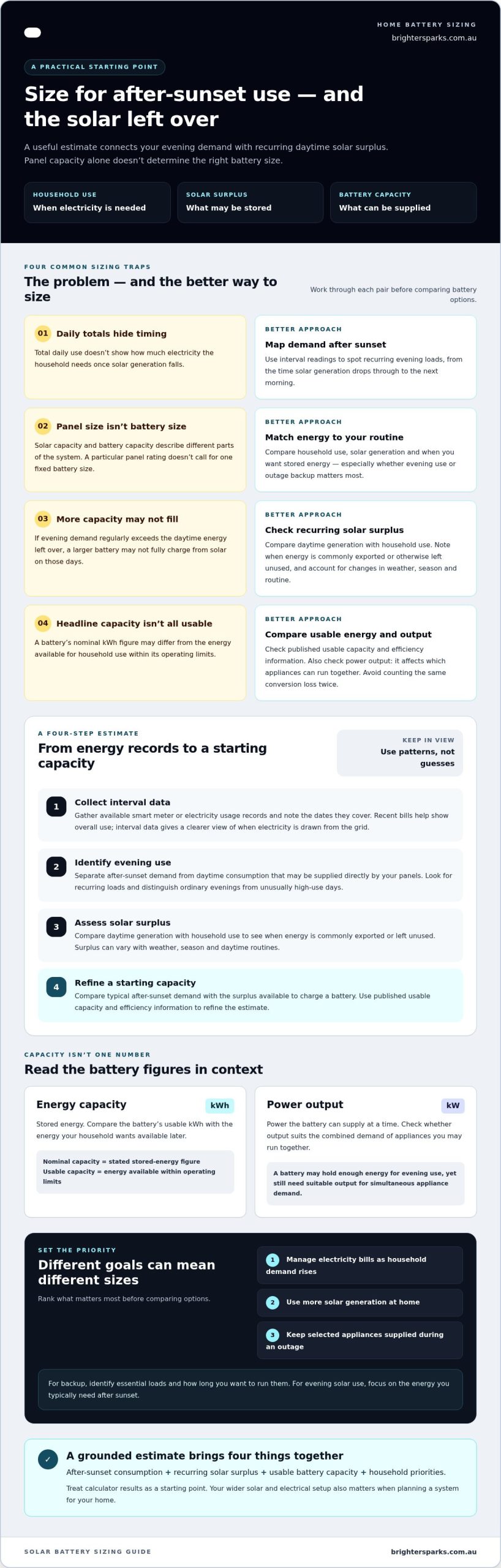
A battery’s nominal capacity is its stated stored-energy figure. Its usable capacity is the energy available for household use within the system’s operating limits. These figures can differ, so don’t assume all the nominal kWh will be available. Compare usable capacity when assessing how much energy a battery could provide in normal operation.
Battery energy capacity is measured in kWh; power output is measured in kW and indicates how much power the battery can supply at a time. Output affects which appliances can run together. For example, a battery may hold enough energy to run appliances over an evening, but its output still needs to suit the combined demand when several are operating at once.
Understanding grid energy storage helps explain the basic role of a battery: energy is stored and released as demand changes. For a home, compare usable kWh and power output together, then relate both to your priorities. A single headline capacity won’t show whether a system suits your routine or intended backup loads.
How to calculate a starting solar battery size from your energy data
A useful estimate matches the energy you want to store with what your household uses after solar generation drops and what your panels commonly leave unused during the day. This makes solar battery system sizing specific to your home, rather than a guess based on panel size or total daily consumption.
Use bills and smart meter data to map household demand
Gather recent electricity data, preferably interval readings from your smart meter if available. Look across representative weeks or months, including periods when routines or seasons change. A daily average can hide a busy evening, a run of cloudy days or higher seasonal use, so note patterns as well as the average.
Find when household demand continues after solar generation falls. Separate that after-sunset use from daytime consumption, which may be supplied directly by your panels. Bills help show overall use, but interval data gives a clearer view of when electricity is drawn from the grid.
Work through these steps in order:
- Collect interval data. Download available smart meter or electricity usage records and note the dates they cover.
- Identify evening use. Review demand from the time solar generation falls through to the next morning. Focus on recurring loads and distinguish ordinary evenings from unusually high-use days.
- Assess solar surplus. Compare daytime generation with household use to see when energy is commonly exported or otherwise left unused. Surplus varies with weather, season and daytime routines.
- Estimate a starting capacity. Compare typical after-sunset demand with the surplus available to charge a battery, then use the battery’s published usable capacity and efficiency information to refine the estimate.
A sensible starting estimate brings together after-sunset consumption, recurring solar surplus, usable battery capacity and the household’s priorities. It isn’t a universal formula. If your evening demand regularly exceeds the energy left over during the day, a larger battery may not be fully charged from solar on those days.
Estimate the energy a battery could store and supply
Use the battery’s published usable capacity, not just its headline nominal figure. Check whether the specifications explain conversion losses or provide an efficiency figure, and use that information without applying the same loss twice. The energy available to the home can differ from the energy originally stored.
SunSPOT can provide an independent estimate using details about your solar setup and electricity use. Treat its result as a guide, not a final specification. Site conditions, existing equipment and system design can affect the practical outcome. For Sydney homes, a property-specific design should also account for the existing solar and electrical setup and applicable local network requirements.
Use your estimate as a starting point for a property-specific design. Brighter Sparks Electrical supplies and installs solar batteries across Sydney. A solar battery system assessment connects your usage figures with the wider solar and electrical setup.
Choose battery capacity by comparing savings, solar use and backup needs
The best capacity depends on what you want the battery to achieve. A bill-focused household may value stored energy during higher-cost periods, while a home aiming to use more solar needs enough surplus to charge the battery. Backup adds another consideration: the system must be designed to supply the circuits and appliances you want available during an outage.
Use this comparison to clarify your priority before weighing capacity options. It’s a guide to the sizing decision, not a recommendation based on household size or panel capacity alone.
| Household priority | What to focus on | Capacity trade-off |
|---|---|---|
| Bill management | When you use grid electricity and how your tariff charges for it. | More storage may help shift solar energy to later use, but value depends on your usage and tariff. |
| Solar self-consumption | How much daytime solar is left over and how much energy the home uses later. | More capacity may capture more surplus, provided there’s enough surplus to charge it. |
| Backup priority | Which circuits and appliances you want powered during an outage. | Capacity must suit the intended energy needs, while the system must also support the required loads. |
If the priority is using more of your own solar
Look at energy that would otherwise be exported during the day, then compare it with household demand later on. A larger battery may store more of that surplus, but it won’t create extra solar energy. Export arrangements and time-of-use tariffs also affect the value of storing energy instead of using or exporting it. Savings depend on your tariff, usage pattern and how the system performs.
Solar battery system sizing shouldn’t assume that extra capacity automatically delivers greater savings. Consider whether your regular daytime surplus can charge the capacity you’re weighing up, and whether your home can use that stored energy later.
If the priority is backup during outages
Backup depends on more than the battery’s stored energy. Compatible equipment and the electrical design determine whether the system can supply power during an outage and which circuits it can support. Decide whether you need selected essential loads, such as lighting and refrigeration, or have broader expectations. Running every household appliance may require a different design from backing up chosen circuits.
How long backup lasts varies with the battery’s charge, the appliances running and the conditions of the outage. High-demand appliances can use available energy faster. Be specific about what you want to operate and include those loads in a property-specific system design.
For a Sydney household, compare your tariff, actual energy use and the system design needed for your priorities. Consider those factors before choosing capacity, rather than relying on a simple rule based on the number of occupants or the size of the solar array.
Use this Sydney household checklist before settling on a battery size
Before comparing capacities or planning a system design, gather a clear picture of how your home uses and produces electricity. This makes solar battery system sizing a practical household assessment, rather than an estimate based on panel capacity or the number of people at home.
- Existing solar system: Record the panel capacity, inverter details and any battery equipment already installed. Note roof orientation and known shading, as these can affect generation.
- Electricity use: Gather recent interval consumption data, if available, and note typical evening demand as well as periods of unusually high use.
- Tariff structure: Check your electricity plan for its usage rates, time-of-use periods and solar export arrangement. These details can affect when stored energy is most useful.
- Backup priorities: List the circuits or appliances you’d want to run during an outage, rather than assuming the whole home needs backup.
- Future loads: Note plans for EV charging, a heating upgrade or other major electrical equipment. Include likely changes to household routines, too.
These details give a system assessment useful context. If you’re planning a new array as well as storage, consider how the battery will fit the broader project and your solar panel installation in Sydney.
Account for changing use and seasonal solar generation
Compare electricity use across seasons, rather than relying on one unusually high or low bill. Winter generation and household demand can both differ from warmer months, affecting how often a battery fills from solar. Include planned appliances in your assessment, but don’t assume every future load will run at once. Focus on likely routines and when those loads will operate.
Check the site, tariff and local network context
Record roof orientation, shading, existing equipment and your retailer’s tariff details for the system assessment. Sydney network requirements can vary by location and distributor, so the applicable connection conditions need to be verified for the property before a design is settled.
Local connection conditions can affect how a solar and battery system is designed for a particular property. Avoid assuming the same export or connection settings apply across Sydney. A property-specific design brings household usage, the solar setup and local requirements together, rather than treating battery capacity as a standalone choice.
With this checklist ready, Brighter Sparks Electrical can use your household information to inform a tailored solar battery system design in Sydney. Arrange a solar battery system assessment as a practical next step.
Turn your solar battery estimate into a system designed for your home
A calculator can turn your energy figures into a useful starting estimate, but it can’t account for every detail of your property or electrical setup. Solar battery system sizing becomes more reliable when the estimate is considered alongside your solar generation, household priorities and site conditions. The aim is not to match a number on a screen, but to shape a system around how your home operates.
Brighter Sparks Electrical supplies and installs solar batteries, solar panels and off-grid solar systems across Sydney. A tailored assessment brings your energy information together with the wider system, helping move from a rough capacity estimate to a design suited to your property.
What a tailored system assessment should bring together
Bring interval electricity data, existing solar specifications and your household priorities into one design discussion. These details show when you use power, how your current system generates it and what you want a battery to achieve. Include future electrical loads as well as everyday use, so the design reflects your likely needs rather than just a snapshot of current consumption.
Battery capacity and output both matter. The design should consider how much usable energy is appropriate and whether the system can support the loads you intend to run, particularly if backup is a priority. Site conditions and applicable network requirements also need to inform the final system design. No single capacity figure suits every home.
Plan a practical next step in Sydney
Before an assessment, organise recent electricity bills and any smart meter interval data you can access. Note your existing solar panel and inverter specifications, your tariff structure and the appliances or circuits you want backed up. Add planned changes, such as EV charging, a heating upgrade or other major electrical work. This preparation helps make the discussion more specific and useful.
If you’re planning solar panels or electrical upgrades as well as a battery, include that work in your plans. The battery needs to fit the broader energy system, not just the current array or one season of household use. Brighter Sparks Electrical supplies and installs solar batteries, solar panels and off-grid systems across Sydney, with system design tailored to the property and its requirements.
You don’t need to have every detail worked out first. Use your estimate and gathered information as a starting point, then move to a property-specific system assessment. Discuss a solar battery system for your home.
Make your estimate the starting point for a confident plan
A battery decision doesn’t need to be settled in one sitting. Treat your estimate as a working brief: it can clarify what you want the system to do and which details still need consideration. As household routines change, the brief helps keep the design discussion focused on your priorities, rather than on a capacity figure for its own sake.
Good solar battery system sizing is about finding a practical fit for your home and its electrical setup. Bring your usage information and plans together with a property-specific assessment. Brighter Sparks Electrical Pty Ltd can help you consider a solar battery alongside solar panels, off-grid systems or electrical upgrades as part of your wider plans.
Ready to move from an estimate to a considered design? Discuss a solar battery system for your Sydney home. A clear starting point can make the next decision feel much more manageable.
Frequently Asked Questions
How do I calculate what size solar battery I need?
Start by reviewing when your household uses electricity and how much solar energy is available to store. Compare interval data from after solar generation falls with daytime surplus, then consider your preferred backup loads and the battery’s usable capacity. This gives you a working estimate, not a guaranteed final specification. For solar battery system sizing, include your tariff and existing equipment so the estimate reflects how your home operates.
Is a 10 kWh battery enough for a house?
It may suit some households, but 10 kWh alone can’t show whether a battery is enough. Check its usable capacity and compare that with the energy you want it to supply. For example, a home that uses modest amounts after sunset may have different needs from one running electric heating or charging an EV in the evening. The battery’s power output also affects which appliances can operate at the same time.
Can a solar battery be too big for my home?
Yes. A battery can have more capacity than your household regularly uses or your solar system can commonly charge. In that case, some capacity may go unused, particularly if daytime surplus is limited. Consider your typical consumption, seasonal changes and planned loads before increasing capacity. A larger unit may still suit a specific backup priority, but that decision should account for the system’s design and how you intend to use it.
Does a bigger solar system need a bigger battery?
No. A larger panel array may generate more energy, but it doesn’t automatically require a larger battery. The useful question is how much surplus generation is available to store and how much energy the household can use later. A home with a larger array but low evening demand may not need extra capacity. Consider battery and panel sizing together with consumption patterns and the property’s electrical setup.
Can a solar battery keep my home running during a blackout?
It can provide backup only if the system is designed and equipped to operate during an outage. The supported circuits and appliances depend on the electrical design, so identify which loads are intended to remain powered. A battery set up for selected essentials may not run the whole home, especially if several high-demand appliances are used together. Backup duration also changes with battery charge and the loads operating.
Does solar battery sizing change between summer and winter?
The battery’s physical capacity doesn’t change with the season, but how often it fills and how much energy the home needs can. Shorter daylight hours or higher heating use may affect the balance between solar generation and household demand in winter. Compare usage and generation across different seasons rather than relying on a single month. This helps set realistic expectations for stored energy throughout the year.
Should I use my electricity bill or smart meter data to size a battery?
Use both if you can. Your bill gives an overview of total consumption and tariff details, while interval smart meter data shows when electricity is being used. That timing matters when distinguishing daytime use from evening demand. If interval records aren’t available, bills can still establish a starting picture. Note unusual periods or changes in routine so they don’t skew your estimate.